
Green Silicon Carbide Powder for Glass Polishing
Key Properties for Glass Polishing
- High hardness (Mohs 9.2–9.5), harder than glass, enabling efficient material removal.
- Excellent self-sharpening – micro-fractures during polishing maintain sharp cutting edges.
- High chemical purity (typically ≥98% SiC) → no staining or contamination on glass surfaces.
- Good thermal conductivity → reduces heat buildup, minimizing thermal stress and edge chipping.
- Narrow particle size distribution → consistent finish, avoids deep scratches.
| Particle Size | Typical Use in Glass Polishing | Surface Finish |
|---|---|---|
| Coarse: F240–F600 | Pre-polishing, edge grinding, removing deep scratches | Semi-fine |
| Medium: F800–F1500 | Fine grinding, pre-polishing for optical/electronic glass | Smooth semi-matte |
| Fine: W20–W5 | High-gloss polishing for flat glass, mirrors | Bright semi-mirror |
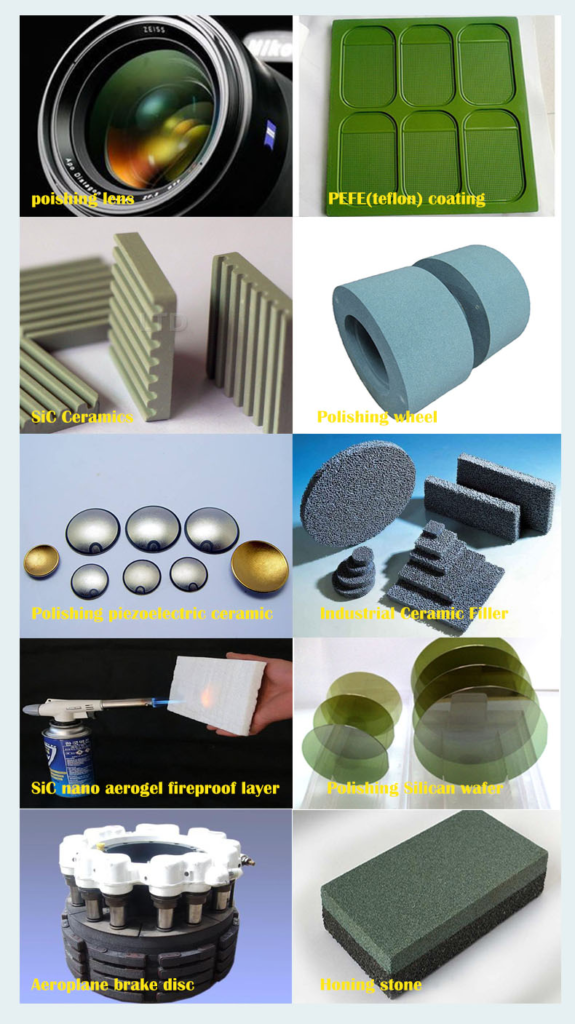
| Superfine: W3–W0.5 | Optical glass, precision lenses, cover glass | Mirror finish, low Ra |
Advantages Over Other Abrasives
- Sharper and more durable than alumina for glass.
- Finer, more uniform finish than black silicon carbide.
- Lower cost than many diamond slurries for general glass polishing.
Common Polishing Methods
- Free abrasive polishing
Mixed with water or polishing fluid to form a slurry, used on polishing pads or laps.
- Bonded tools
Resin-bonded wheels, stones, or pads for edge polishing and surface finishing.
- Lapping & CMP processes
Used in high-precision optical and electronic glass manufacturing.
Recommended Usage Tips
- Use high-purity grades (SiC ≥99%) for optical and electronic glass to avoid impurities.
- Use a dispersant in slurry to prevent agglomeration.
- Match particle size to the required surface roughness (Ra).
- Rinse thoroughly between polishing steps to avoid cross-contamination from coarser grits.