
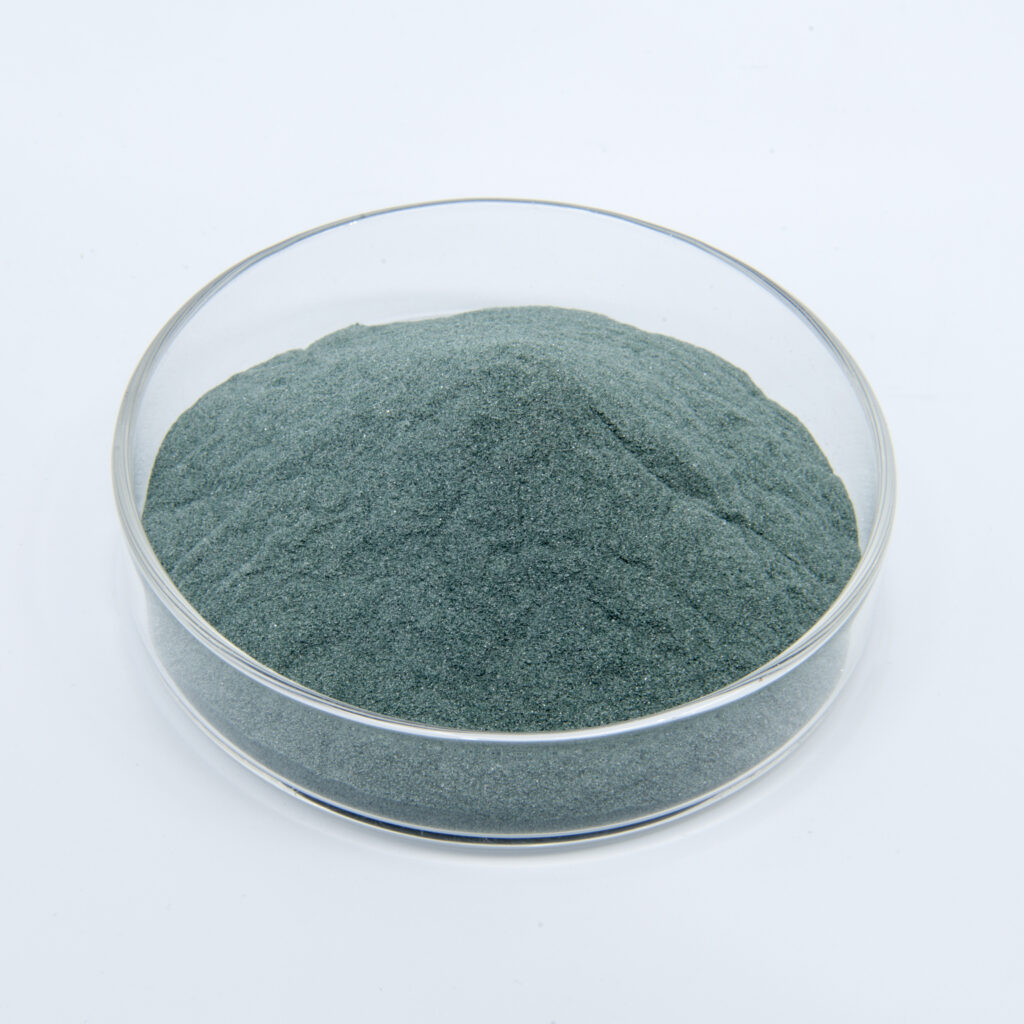
Green Silicon Carbide for Hard Alloy Blasting
Advantages
Superior Hardness & High Blasting Efficiency
Green silicon carbide features a microhardness of 3200–3400 HV, far harder than fused alumina abrasives. Its sharp angular grains deliver powerful impact cutting action, which effectively removes burrs, sintering residues and surface scales on high-hardness cemented carbide (89–92 HRA). The blasting efficiency is markedly higher than that of brown and white fused alumina.

Excellent Self-Sharpening Performance
Moderate brittleness enables SiC particles to fracture under impact force and continuously generate brand-new sharp cutting edges. Long-term blasting will not cause abrasive passivation or simple rubbing/polishing on workpiece surface. It avoids surface plastic deformation, residual stress and microcracks on cemented carbide components.
High Chemical Stability Without Workpiece Contamination
High-purity green SiC contains extremely low iron impurities, eliminating iron contamination on carbide surfaces which would otherwise damage subsequent coating layers. It is chemically inert against tungsten carbide (WC) and cobalt binder (Co) under instantaneous high temperature during blasting, preventing surface decobaltation and thermal embrittlement.

Low Heat Generation to Prevent Thermal Damage
Good thermal conductivity quickly dissipates localized impact heat during blasting. This effectively avoids cobalt phase softening, edge chipping and hidden thermal cracks on carbide cutting tools, drills and precision dies.
Controllable Surface Roughness & Uniform Texture
Different grit sizes achieve customized surface effects: coarse grits for heavy material removal and edge chamfering; fine grits for uniform surface texturing, cutting edge passivation and pre-treatment to enhance PVD/CVD coating adhesion. It will not collapse delicate sharp edges of precision hard alloy parts.
Outstanding Cost-Effectiveness
Compared with expensive diamond blasting media, green silicon carbide has a much lower procurement cost, good impact resistance and recyclability. It serves as the most economical and reliable mainstream abrasive for mass production blasting of cemented carbide workpieces.

Main Applications
- Deburring and edge passivation of carbide inserts, end mills and drill bits
- Stress relief and surface cleaning of tungsten carbide molds and wire drawing dies
- Surface roughening before coating for improved bonding force
- Removal of oxide layers and sintering residuals on sintered cemented carbide blanks