
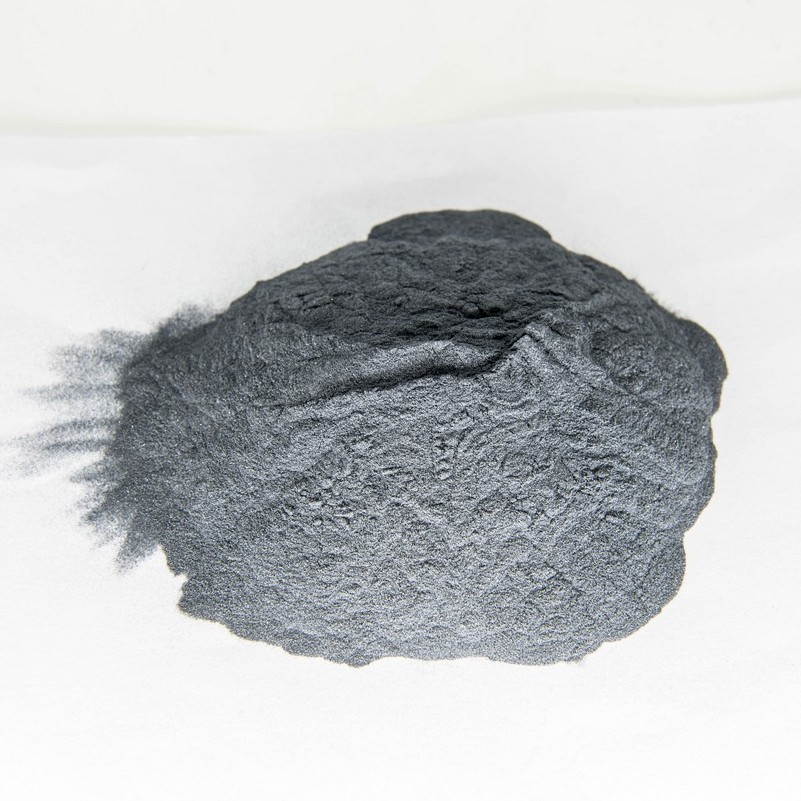
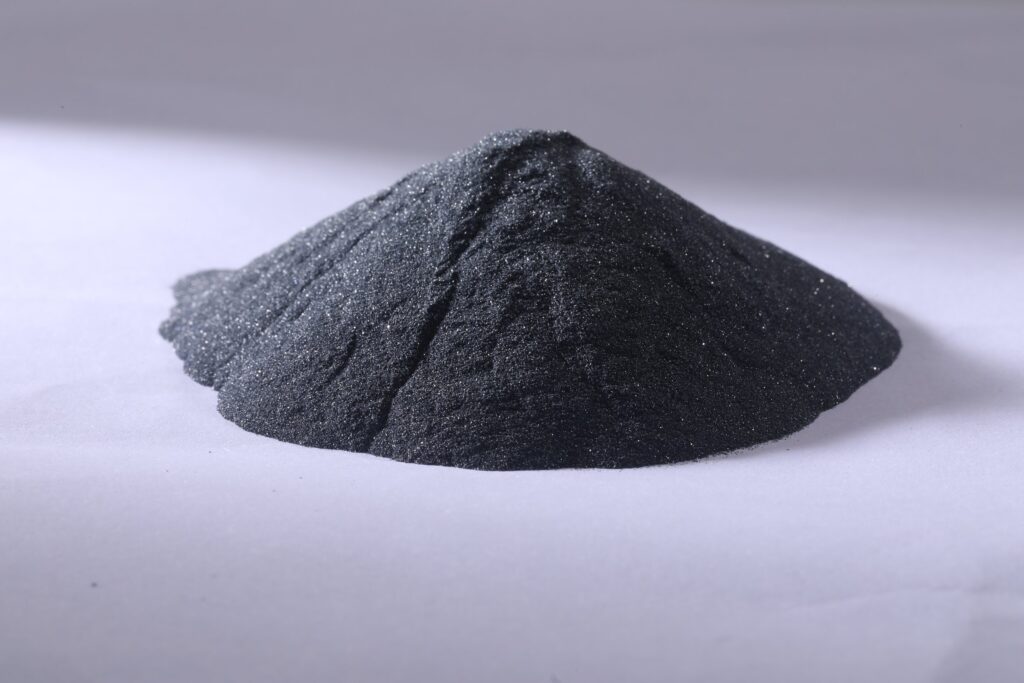
Black silicon carbide (SiC) micropowder is a high-performance abrasive and material additive known for its exceptional hardness (9.2-9.5 Mohs), high thermal conductivity, chemical inertness, and excellent wear and thermal shock resistance. Its application scope spans numerous traditional and advanced industrial fields, as detailed below:
1. Abrasives and Polishing
This is the most classic and widespread application area.
Precision Grinding: Used in bonded abrasives (wheels, stones) or coated abrasives (sandpaper, belts) for grinding metals, alloys, ceramics, and stone.
Lapping and Polishing: As a free abrasive in slurry form for ultra-precision surface finishing of:
Semiconductor Wafers: Silicon, sapphire, and other substrate materials.
Optical Components: Lenses, mirrors.
Technical Ceramics.
Wire Sawing: Suspended in slurry for multi-wire saws to slice ingots of silicon, quartz, and other brittle materials.
2. Refractories and Foundry
A key additive to enhance the performance of high-temperature materials.
Refractory Bricks and Monolithics: Added to alumina, magnesia, or zirconia-based refractories to improve:
Thermal Shock Resistance
Abrasion Resistance
Slag/Corrosion Resistance
Used in blast furnaces, steel ladles, cement kilns, and incinerators.
Foundry: Used as a mold wash or in mold-making sands for casting ferrous metals.
3. Wear-Resistant and Composite Materials
Utilized as a reinforcing phase to dramatically improve hardness and durability.
Reinforced Metals: Added to aluminum (Al-SiC), magnesium, or other metal matrices to create lightweight, high-strength, and wear-resistant composites for automotive (pistons, brake rotors) and aerospace components.
Reinforced Ceramics: Improves the toughness and thermal shock resistance of ceramic composites (e.g., Al₂O₃-SiC).
Wear-Resistant Coatings: Incorporated into thermal spray coatings, polymer-based coatings, or ceramic plates for industrial floors, mining equipment, pump seals, and cyclones.
4. Advanced Technical Ceramics
Used as a primary material or sintering aid for high-performance SiC ceramics.
Structural Parts: Sintered into components like seals, bearings, nozzles, and blast nozzles that operate under extreme conditions of temperature, wear, and corrosion.
Kiln Furniture: Plates, setters, and beams for sintering other ceramics due to its high-temperature strength and creep resistance.
5. Functional Fillers
Leveraging its thermal and physical properties.
Thermal Interface Materials: As a high-thermal-conductivity filler in greases, pads, adhesives, and potting compounds for electronics cooling (LEDs, CPUs, power modules).
Polymer Composites: Enhances the thermal conductivity, stiffness, and abrasion resistance of plastics and rubbers.
Conductive Composites: Can be used to tailor the electrical properties of composites.
6. Other Specialized Applications
Aerospace & Defense: In composites for lightweight armor or components in high-heat-flux environments.
Antislip Aggregate: For industrial flooring, deck coatings, and non-slip surfaces.
Filtration: Sintered into porous ceramics for hot gas or molten metal filtration.
Ancillary Uses: As a blasting medium or in the production of certain friction materials.
Key Selection Factors for Application
Grit Size/Particle Size Distribution: Determines surface finish (finer for polishing, coarser for grinding).
Purity: Higher purity (≥98.5%) is critical for semiconductors, electronics, and advanced ceramics.
Particle Shape: Angular particles are better for aggressive grinding; more rounded particles can improve slurry flow and surface finish in polishing.
Chemical Treatment: Surface coating (e.g., silane) can improve compatibility and dispersion in polymer or metal matrices.