
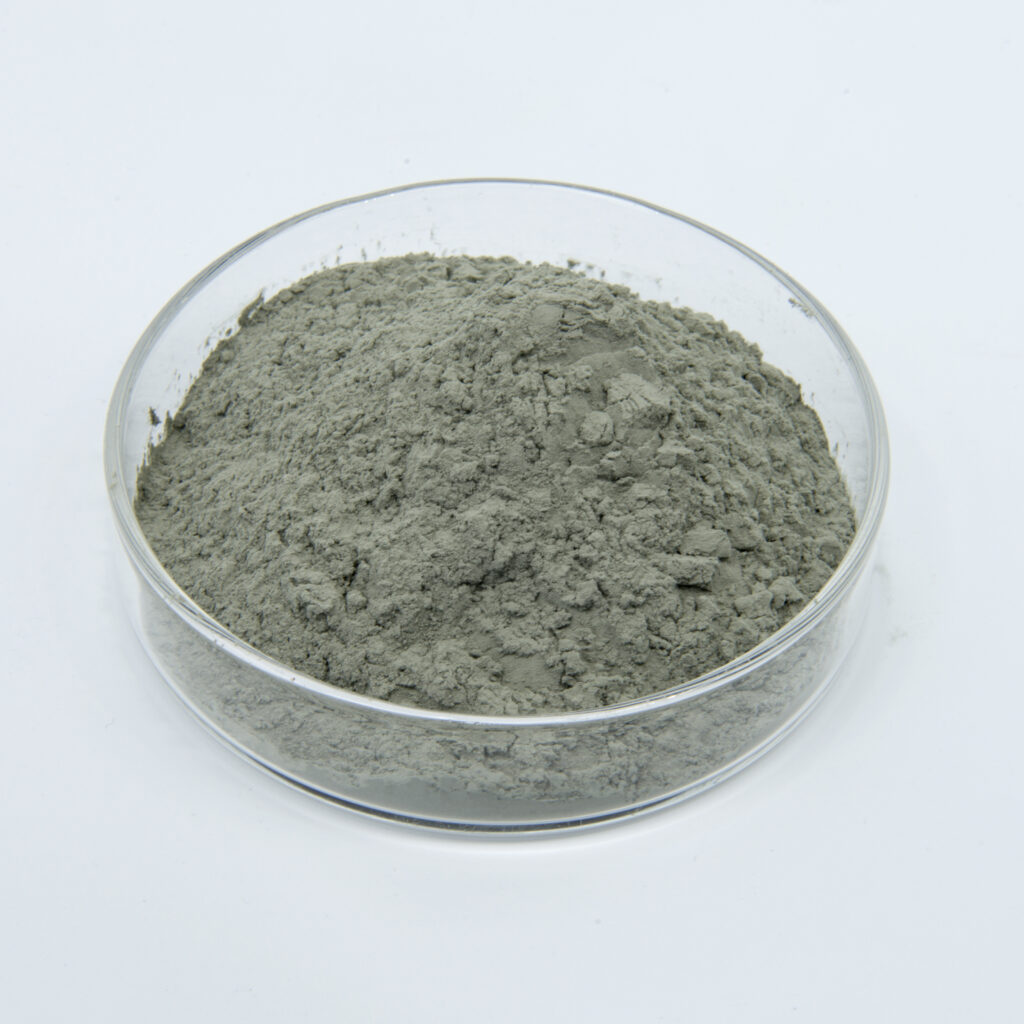
Green silicon carbide (SiC) polishing powder is a high-performance abrasive material widely used in precision surface finishing across various industries.
Core Characteristics & Manufacturing
Chemical Composition: Primarily silicon carbide (SiC) with ≥99% purity. The distinctive green color results from:
Ultra-low impurity content (especially iron, aluminum)
High crystalline perfection
Controlled stoichiometry of silicon and carbon
Physical Properties:
Hardness: 9.2-9.5 on Mohs scale (Knoop hardness ~2800 kg/mm²)
Melting Point: Decomposes at ~2700°C (does not melt)
Thermal Conductivity: 120 W/m·K (excellent heat dissipation)
Density: 3.2 g/cm³
Production Process:
Furnace Synthesis: Acheson resistance furnace (2200-2500°C)
Purification: Acid washing, magnetic separation, flotation
Micronization: Jet milling, ball milling, or sedimentation
Classification: Hydrocyclone separation, centrifugation
Quality Control: Laser particle sizing, SEM analysis
Key Technical Advantages
Superior Micro-Hardness: Effectively processes hard materials
Sharp Fracture Pattern: Maintains fresh cutting edges (self-sharpening)
Controlled Particle Morphology: Blocky/angular shapes for aggressive cutting
Chemical Inertness: Minimal workpiece contamination
Narrow Particle Distribution: D90/D10 ratio typically <2.0 for premium grades
Primary Applications
| Industry | Specific Applications | Typical Grit Range |
|---|---|---|
| Optics | Lens elements, prisms, optical glass, display panels | W40-W1.0 |
| Semiconductors | SiC wafer thinning, GaAs substrate processing, quartz oscillators | W14-W0.5 |
| Precision Engineering | Hard alloy tools, ceramic seals, bearing balls | W28-W3.5 |
| Stone Processing | Granite/marble fine polishing, engineered stone | W40-W10 |
| Advanced Ceramics | Structural ceramics, wear-resistant components | W20-W5 |